Introduction
eSUN-Yomikaki is a supplementary course for
eSUN.
eSUN-Yomikaki is designed to teach how to read and write Japanese characters efficiently.
eSUN-Yomikaki introduces more than 800
kanji
characters used in
eSUN.
Stroke-order, explanation, and pronunciation for each character can be practiced by typing, listing to examples, and using printable worksheets.
The Japanese writing system uses three different sets of characters:
Katakana,
Hiragana and
Kanji (Chinese characters).
Each
Katakana and
Hiragana character represents one sound, and must simply be memorized.
Kanji, however, is pretty challenging. The difficulty lies in how to read the
Kanji, as most of them have at least two readings.
These two readings are called the
On reading (based on the original Chinese sound) and the
Kun reading (a Japanese word corresponding to the character's meaning).
In addition, there are a large number of words made up by a combination of two or more
Kanji.
By studying both eSUN and eSUN-Yomikaki you will understand the characters as efficiently as possible.
Structure
Hiragana
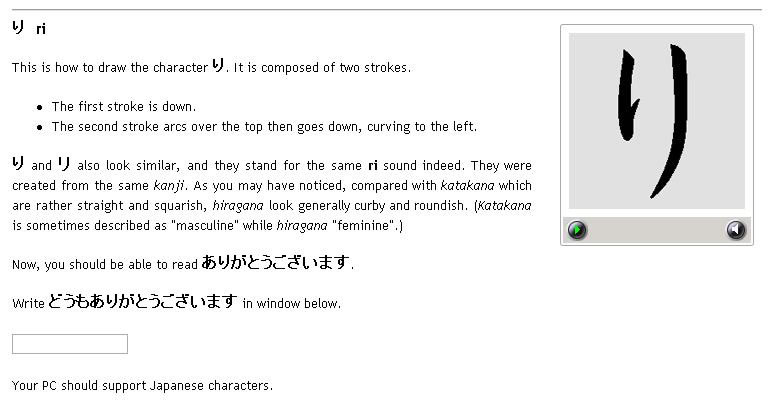
Core parts of Japanese verbs, adjectives and nouns are usually written in kanji but their inflecting parts are written in hiragana. Hiragana is also used for instrumental words such as particles, prefixes, suffixes, etc.
- Explanation
- Pronunciation
- Stroke-order
- Work Sheet (for practicing writing by hand)
- Textbox (for practicing typing)
Kanji
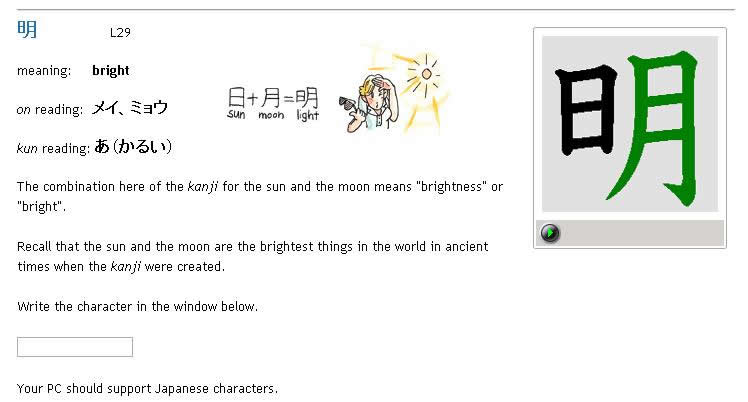
Here we introduce all the Kanji introduced in eSUN. By studying eSUN, you will know the pronunciation of each character which will help you memorize each character in an efficient and effective way.
- Explanation
- Work Sheet (for practicing writing by hand)
- Textbox (for practicing typing sentences used in eSUN)
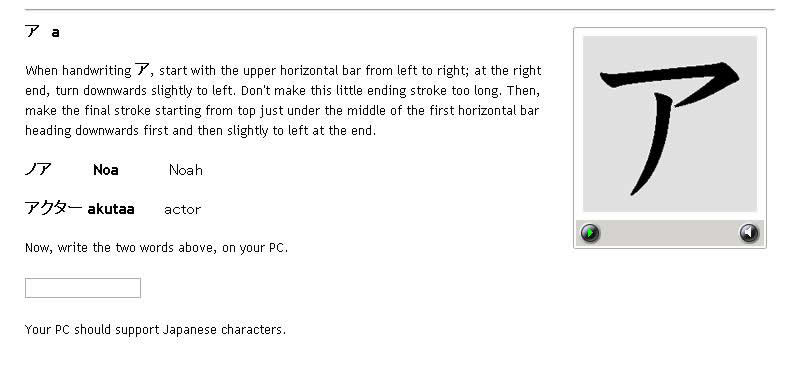
Katakana
Katakana is predominantly used when expressing foreign names and loanwords. It is, therefore, presented at the beginning, so that you can relate the characters with your familiar words and see how the original sound is distorted when used as Japanese.